
What Is a North Node? Meaning in Astrology
What is a North Node? It is one of the two points where the Moon's orbit crosses the ecliptic, the Sun's apparent path through the sky. In astrology, North Node meaning is about direction: the sign it occupied when you were born describes a way of living that feels unfamiliar and worth moving toward, while the South Node opposite describes skills you already use without thinking.
In this article
What is a North Node? It is one of the two points where the Moon’s orbit crosses the ecliptic, the Sun’s apparent path through the sky. In astrology, North Node meaning is about direction: the sign it occupied when you were born describes a way of living that feels unfamiliar and worth moving toward, while the South Node opposite describes skills you already use without thinking.
Neither node is a planet or any kind of object. They are geometry, the places where two circles meet, and astrologers have read them for a very long time. Medieval European texts called them the Dragon’s Head and the Dragon’s Tail; Indian astrology knows them as Rahu and Ketu. This guide covers the astronomy first, then the difference between the true node and the mean node, how this site reads the North Node and South Node as a pair, and a short line on each of the twelve signs. If you only want your own placement, the North Node Calculator finds it from your birth date.
What the lunar nodes are in the sky
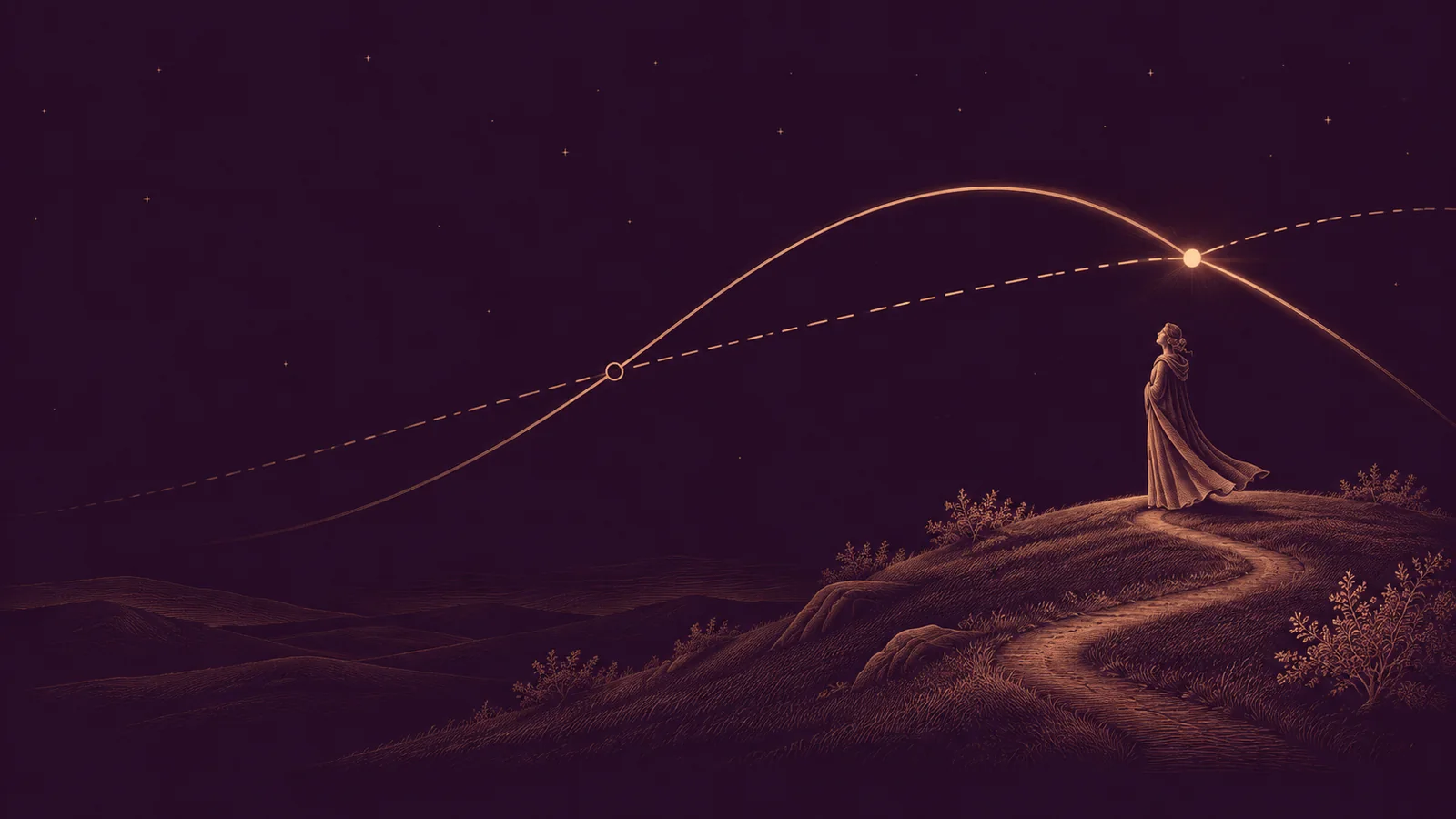
Seen from Earth, the Sun appears to travel the same circle through the zodiac every year. That circle is the ecliptic. The Moon follows a circle of its own, tilted about five degrees from the Sun’s, and two tilted circles always meet at two points. Where the Moon crosses the ecliptic heading north is the ascending node, which astrology calls the North Node. Where it crosses heading south is the descending node, the South Node. Because the two points sit on opposite sides of the same circle, the nodes are always exactly 180 degrees apart.
The crossing points do not stay put. The Sun’s gravity slowly turns the plane of the Moon’s orbit, and the nodes slide backward through the zodiac, against the usual order of the signs, by about 19 degrees a year. One full circle takes about 18.6 years, which works out to roughly eighteen months in each sign. That is why people born within the same year and a half usually share a North Node sign, and why the sequence runs from Aries back into Pisces and then into Aquarius rather than forward into Taurus.
The nodes also explain eclipses. There is a New Moon and a Full Moon every month, but an eclipse happens only when one of them falls close to a node, so that the Sun, Earth and Moon line up in depth as well as on the flat map of the zodiac. The Sun passes each node about once a year, so eclipses come in seasons roughly six months apart, and the signs where they fall shift backward along with the nodes. The word ecliptic itself comes from this: it is the line along which eclipses can happen.
True node and mean node
There are two standard ways to calculate the nodes. The mean node is an average. It moves backward at the same smooth rate every day. The true node follows the Moon’s actual orbit as the Sun tugs on it, so it wobbles around the mean position, sometimes ahead of it and sometimes behind, and for a few days at a time it can even appear to move forward. The gap between the two is usually under a degree and a half.
Most of the time this makes no difference to your sign. It matters only if you were born within a few weeks of the day the node changed sign, when one method can place it at the very end of one sign and the other at the start of the next. That is the usual reason two websites give you different answers. Both are honest calculations of the same crossing. The calculator on this site uses the true node and shows the mean node beside it, so you can see at a glance whether your birth date sits in that narrow overlap.
How to read the North Node and South Node
Astrologers read the two nodes as one line through the chart, the nodal axis. Each end describes something, and neither makes much sense alone. Here the North Node is read as a direction you are allowed to grow toward: habits that feel slightly awkward, ways of living you have not practised much. The South Node is read as what you already know how to do, the fluent skill other people rely on you for.
That second half deserves care, because many descriptions treat the South Node as something to escape. This site does not. A skill only becomes a habit when it is the sole tool you ever reach for, and the North Node is simply the other tool, lying at the far end of the line. Nobody has to give up the South Node to grow toward the North. Most people use both in the same week, often in the same conversation.
Take the axis of Cancer and Capricorn. Someone with a Capricorn South Node may be the friend who handles every crisis calmly and has the spreadsheet open before anyone else has finished talking. Her Cancer North Node invites something smaller and harder: letting a friend bring her dinner on the week she is the one struggling. The competence stays exactly where it was. The new part is letting it rest for an evening.
The sign describes the manner of that growth. A reading that would work just as well with any other sign swapped in is too generic to help, which is why each of the twelve pages below describes specific everyday behaviour at both ends of its axis.
The twelve North Node signs
Because the nodes are always opposite, the twelve signs form six axes, and each axis can run in either direction. Find your North Node sign below; its South Node is the sign named beside it.
Aries and Libra
- A North Node in Aries, with the South Node in Libra, grows toward choosing for yourself first after years of reading what everyone else wants.
- A North Node in Libra, with the South Node in Aries, grows toward letting someone else weigh in when doing it alone has always been quicker.
Taurus and Scorpio
- A North Node in Taurus, with the South Node in Scorpio, grows toward the slow and ordinary: a plain week enjoyed without turning it into a test.
- A North Node in Scorpio, with the South Node in Taurus, grows toward letting something change you after a long habit of keeping things comfortable.
Gemini and Sagittarius
- A North Node in Gemini, with the South Node in Sagittarius, grows toward asking a second question before reaching the conclusion you already had.
- A North Node in Sagittarius, with the South Node in Gemini, grows toward saying what you believe instead of collecting one more opinion.
Cancer and Capricorn
- A North Node in Cancer, with the South Node in Capricorn, grows toward being looked after by people who have mostly been looked after by you.
- A North Node in Capricorn, with the South Node in Cancer, grows toward responsibility chosen out loud, in a role that carries your name.
Leo and Aquarius
- A North Node in Leo, with the South Node in Aquarius, grows toward taking up visible room instead of thinking only for the group.
- A North Node in Aquarius, with the South Node in Leo, grows toward being one of many for someone used to being the warm centre of the room.
Virgo and Pisces
- A North Node in Virgo, with the South Node in Pisces, grows toward the useful and specific: one feeling turned into one task you can finish.
- A North Node in Pisces, with the South Node in Virgo, grows toward leaving something unfinished and letting rest go unexplained.
The house: where the axis lands
Two people with the same North Node sign can feel it in quite different parts of life, because the house adds a setting to the sign. A North Node in the 10th house is read through public work and reputation, with the South Node in the 4th, at home. Reverse them, with the North Node in the 4th, and the growing edge gathers around family and private life instead. In the 7th it centres on one close partnership, with the South Node in the 1st, in the way you handle things alone. The house depends on your exact birth time and the city where you were born, so the sign by itself cannot tell you which of these is yours.
How to find your North Node
Start with your birth date. Since the nodes stay in a sign for about eighteen months, the date settles it for almost everyone. The Moon itself works differently: it changes sign every two and a half days or so, which is why a Moon sign often needs a birth time and a North Node sign seldom does.
The exception is a birth date on which the node changed sign. On those days the free North Node Calculator lists both signs, and a recorded birth time and city settle which one is yours. The same details give the exact degree of each node and the house it falls in. Near a boundary a guessed time can be worse than none, so use a time from a birth certificate or a family record if you have one.
The natal node and the node today
Everything above concerns the natal node, its position when you were born. The nodes are also moving right now, and articles about where the North Node is this year describe that transit, which everyone alive shares at once. Your natal sign does not change. About every 18.6 years, near ages 18 or 19, 37 and 56, the moving node comes back to the place it held at your birth. Astrologers call this a nodal return and treat it as a good time to look at the axis again, without reading it as a forecast of any particular event.
A question to try once you have looked up your sign: which end of your axis do people thank you for, and which end have you hardly let anyone see? You are allowed to read this and decide none of it fits.
For entertainment and self-reflection only. Astrology is not scientific evidence or a prediction, and this page does not tell you what to decide.